Astrology Glossary M–R

- MC
- See Medium Coeli
- Malefic
- A term used in Classical and Medieval/Renaissance Astrology that refers to planets or aspects thought to have negative influence on the native. It usually refers to the planet Saturn and Mars, the Major Malefics (or Greater) . In modern Astrology minor Malefics (or Lesser) are also Uranus, Neptune and Pluto.
- Medium Coeli, Med. Coeli, MC
- The Midheaven. Taken to be the point directly overhead. In the chart in an unequal chart it is the cusp of the tenth house. This describes your career and public ambitions and your relations with superiors.
- Midheaven
- The point when the Meridan of the birthplace intersects the ecliptic. Defined as the cusp of the 10th house in most house systems, See also Medium Coeli, Mid. Coeli, MC
- Moon Nodes
- The astronomical calculation of when the Moon's orbit intersects with the Sun's orbit. The two intersecting points located opposite each other in the Zodiac are differentiated by ascending and descending or more commonly, North and South Nodes. If the Sun and the Moon are positioned at one of these nodes, there is a solar eclipse. In Karmic Astrology the Moon Nodes have a leading role.
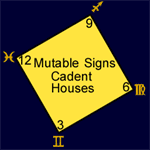
- Mutable Signs (a.k.a. common)
- The
signs Gemini,
Virgo,
Sagittarius
and Pisces.
Signs associated with adaptability and flexibility.They also correspond
to the Cadent
Houses in the Wheel identified as part of the
Quadruplicities.
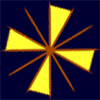
- Mutual Reception (see diagram)
- Two
planets are said to be in mutual reception when they are in each
other's signs of rulership. The example in the diagram is
Mars in Taurus and Venus in Aries.Each planet has influence over
the others' sign. Referring to one directs you to the other
and then refers you back to the originating planet. Much like
an endless loop. Because they are in each other
signs they mutually support each other.

- Nadir
- See Imum Coeli
- Natal Chart see also Horoscope
- A chart of the solar system based on the Birth Data of an individual.
Natural
Houses or Flat Chart
The display of the horoscope
wheel houses beginning with Aries as the first house cusp
then Taurus, Gemini, etc. in order, continuing counter clockwise
until the 12th house, Pisces,
meets the first house, Aries.
- Node
- The point of interception between a planet's orbit and the ecliptic. See also Moon Nodes
- North Node
- see Moon Nodes
- Novile
- A
minor aspect between two planets or points that measures 40°.
Some interpretations include brooding, realization and/or redemption.
The glyph for the Novile varies according to the software
program. Some just use the capital "N" and others have
more elaborate symbols as
 .
(See Legend)

- Occultations
- Usually referred to when the Moon eclipses another object in the sky particularly a smaller object from our view on Earth. The word is derived from the Latin root "occult" which has nothing to do with the supernatural and simply means "to conceal or hide". An animated example can be viewed here. Some Astrologers interpret according to what the Moon is eclipsing and for how long.
- Orb
- The difference between an exact aspect and the actual aspect. It also describes the maximum difference where an aspect still takes place. This is the amount allowed on either side of an aspect to be considered valid. For example: a square is an aspect of 90°. If an aspect falls within 85° to 95° of each other it would be considered "in square." Individual astrologers assign the orb for the chart based on their own research and data. This varies from one astrologer to the other.

- Parallel
- An aspect in declination where two planets are in the same degree (with an orb of 1 degree), both North or both South of the celestial equator. Read by most astrologers as similar to a conjunction.
- Peregrine
- Planet positioned in a sign where it posesses no essential dignity. It is neither dignified nor debilitated. It is a planet that seems to be independant of others. In interpretation in Horary Astrology, the astrologer determines if it could be a debility by where it is placed in degrees and relationship to angles of specific houses as appropos to the question. Planets that enjoy mutual reception can not be considered peregrine. The simple determination on whether or not a planet is peregrine is if it is unaspected.
- Placidus
- Spanish Monk. Placidus de Tito, 17th century. Creator of the Placidus House System. One of the most commonly used house systems today.
- Planets
- The planets in Astrology are considered the TEN planets: Sun, Moon, Mercury, Venus, Mars, Jupiter, Saturn, Uranus, Neptune and Pluto. However, this is an astronomical error because the Sun and Moon are not considered planets by the strictest definition. This definition of the planets dates back to the times when the Earth was considered the center of Universe. The Sun and the Moon are considered the Luminaries or Lights in astrology although treated as planets. It is important to note that western astrology has extended astronomical discoveries to the science. Chiron is now treated as a Planet although considered a planetoid or rogue asteroid between Saturn and Uranus. Asteroids alone are now considered part of the equation in erecting a chart for individual. The science of Astrology progresses along side the science of Astronomy.
- Precessions
- The slow advancement of the fixed-star heavens through the movement of the Earth's axis. Therefore, the constellations, which gave the signs of the zodiac their names, move another 1° every 72 years. The result is the advancement of the firmament for the length of an astrological sign (30°) every 2160 years. This movement is designated in Astrology as new era or age (e.g. Aquaria Age). As a result western Astrology sees the constellations as only donors of their name to the science, precessions are not as emphasized in the western practice of Astrology.
- Predictive Astrology see Current Patterns.
- Progressions
- Term used for advancing planets and house cusps from birth to a second point in time. Usually one day for each year. The systems of studying current patterns that move the chart symbolically forward or backward according to one unit of time equated with another. The most common form, secondary progression, is the usual one day for each year. Thus if a person is now 30 years old, the positions 30 days after birth are considered symbolic of that of the 30th year. Other systems of progressions equate a lunar month with a year, ad with a lunar month and so on.
- Ptolemaic Aspects
- The aspects that are considered MAJOR. Opposition, Trine, Square and Sextile as well Conjunction.

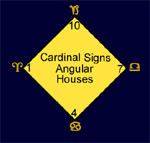
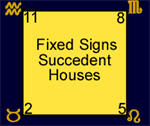
- Quadruplicities
- The qualities of the astrological zodiac signs defined as either, Cardinal, Mutable or Fixed. Also describing the Natural Houses qualities. Also known as Modes.
 |
 |
 |

- Regiomontanus
- German Astrologer, (Johannes Müller) 15th century, who devised the Regiomontanus House System. The House system most often used in Classical Horary Astrology.
- Relative House or Relationship Houses
- Houses
3, 7 and 11. Associated with the Air
Signs.
- Retrograde
 Apparent
backward motion of a planet as appearing from the Earth. Thought
to cause difficulty in a person's chart. Click here
for an animation of what astronomically is happening!
- Ruler
- Each astrological sign and house is governed by at least one planet (or body). The planet is said to rule that sign or house. In the opposing sign and/or house, the planet is in its detriment or fall. Example: Aries is ruled by Mars and is opposite of Libra. Mars in Libra would be considered in detriment. A planet that is positively placed is considered exalted if in the sign that is complementary. Example: Mars in Aries would be considered dignified or dignity. It would be exalted in Capricorn and Fall in Cancer the opposite of the exaltation. (see Table of Planetary Rulership)